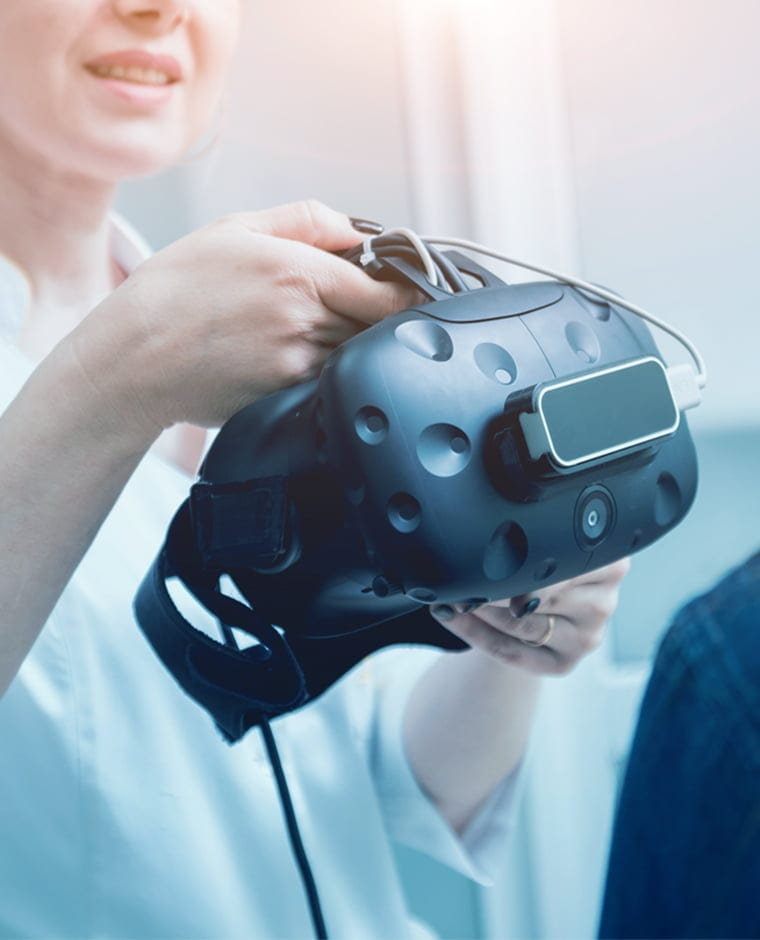
The impact of virtual reality therapy on mental health is a promising and rapidly growing field, offering unique opportunities for patients.
In Romania, ID Therapy Bespoke Treatment Center is the only clinic representing Virtually Better, Inc.®, USA, providing patients with virtual-therapy systems for the treatment of various conditions, including:
- Anxiety treatment (relaxation exercises for anxiety)
- Panic attack management (relaxation techniques during a panic attack)
- Treatment for fear – specific phobias (aviophobia, glossophobia, astrophobia, cynophobia, acrophobia, arachnophobia, gephyrophobia, brontophobia, aichmophobia, nyctophobia)
- Alcohol and tobacco addiction
During VR therapy, patients use VR devices—such as virtual reality headsets—that display 3D images and ambient sounds, creating the impression of being physically present in a virtual environment.
Within this immersive setting, patients can interact with digitally created elements, characters, or scenarios, allowing them to confront various issues—from anxiety and phobias to post-traumatic stress disorder and addictions—in a controlled, therapeutic environment tailored to individual needs.
This controlled environment also allows therapists to closely monitor and guide patients’ reactions and behaviors, facilitating learning, adaptation, and emotional regulation.
Exposure-based therapy, also known as Virtual Reality Therapy (VR), is suitable for individuals of all ages who seek effective solutions for:
- Anxiety treatment and relaxation techniques for panic attacks
- Fear and phobia treatment
- Post-traumatic stress disorder treatment
- Addiction treatment
- Other emotional or behavioral difficulties
This method is particularly valuable for those seeking alternative or complementary approaches to traditional psychotherapeutic treatments.
VR therapy is especially effective for the following individuals and situations:
- People with specific phobias Such as: Fear of flying, Fear of public speaking, Acrophobia (fear of heights), Astrophobia (fear of thunder and lightning), Claustrophobia, Cynophobia (fear of dogs), Arachnophobia (fear of spiders), Nyctophobia (fear of the dark) or Trypanophobia (fear of needles)
- Individuals living with anxiety, Anxiety can feel overwhelming and difficult to manage. Effective treatment involves therapeutic approaches combined with relaxation exercises for anxiety, such as: mindfulness, 4-6-4 breathing, sau Autogenic training. These help reduce psychological tension, enhance well-being, and provide tools for coping with emotional challenges.
- Individuals experiencing panic attacks. Relaxation exercises practiced in the virtual environment offer an accessible and efficient way to manage panic attacks, including: Deep breathing, Progressive muscle relaxation, Guided visualization.These techniques calm the mind, relax the body, and shift focus away from panic-triggering sensations.
- People struggling with alcohol or tobacco addiction VR exposure can support motivation, self-control, and recovery through structured, therapeutic scenarios.
Virtual Reality Therapy (VRT) offers numerous advantages for both patients and therapists. Key benefits include
- Detailed control over scenarios: The therapist can adjust elements such as time of day or weather for fear-of-flying simulations. Gradual exposure reduces fear responses.
- Reduced costs: Compared to real-world exposure sessions requiring travel.
- High accessibility: VR surpasses visualization-only techniques by offering immersive scenarios even when real exposure is impractical.
- Repetition and flexibility: Scenarios can be repeated and customized, leading to desensitization and symptom reduction.
- Personalized treatment: Therapy is tailored to each patient's specific needs.
- Accelerated learning: VR environments promote faster progress than real or imagined exposure alone.
- Increased confidentiality: Provides discretion without exposing the client to public environments.
- Higher acceptance rate: Often better received than traditional psychotherapy methods.
- Optimal session length: A VR therapy session typically lasts 45–50 minutes, combining immersion with therapist-guided discussion.
Virtual Reality Therapy at ID Therapy Clinic can treat a wide range of conditions:
- Specific phobias, including fear of flying, public speaking, spiders, dogs, heights, injections/medical procedures, claustrophobia/MRI, and astrophobia
- Addictions (alcohol, nicotine).
- Anxiety management and panic attacks.
- Post-traumatic stress disorder, depression, and even chronic pain management.
Although VR therapy has many benefits, it also presents some limitations:
- Accessibility and technological costs
- Possible discomfort or motion sickness (similar to watching 3D movies)
- Mild headaches, dizziness, or blurred vision for some individuals
- Not suitable for everyone—people with certain cardiac or psychiatric conditions must consult their physician first
- Works best when combined with other therapeutic approaches
The duration of VR therapy varies depending on each case and individual response. Typical sessions last 20–60 minutes.
VR therapy consists of three stages:
- Evaluation & diagnostic assessment
- Anxiety management
- Virtual reality exposure therapy
On average, the full therapeutic process involves 10–12 sessions. During these sessions, patients experience virtual scenarios that replicate the triggers for their phobias or addictions.
The VR psychotherapy protocol includes three main steps
- Evaluation & Diagnostic Assessment: A general overview of the program, discussion of symptoms and reasons for therapy, and identification of triggers.
- Anxiety Management: In sessions 2 and 3, the patient is taught Relaxation techniques and Cognitive restructuring strategies. These prepare the patient for VR exposure.
- VR Exposure Sessions: Between 8 and 12 virtual exposure sessions gradually introduce the patient to fear- or addiction-related stimuli in a controlled, therapeutic way.
In the first session, the therapist conducts a thorough assessment, discusses therapy goals, explains how VR technology works, and familiarizes the patient with the virtual environment.
Those interested in VR therapy for anxiety management or specific phobias can access structured therapeutic packages.
- Anxiety Management Package:
- Price: €300
- Includes: 5 sessions of rhythmic deep-breathing relaxation (20 minutes each) + 5 sessions of autogenic training (30 minutes each)
- Individual VR Exposure Sessions for Specific Phobias::
- Price per session: €150 for a 45-minute session
- Depending on initial anxiety levels, 8 to 12 sessions may be required